
Alocasia Frydek Variegated Care Guide
Plant Journal — Aroid Collection No. 14
The Alocasia Frydek
Variegated, understood.
Alocasia micholitziana ‘Frydek’ variegata
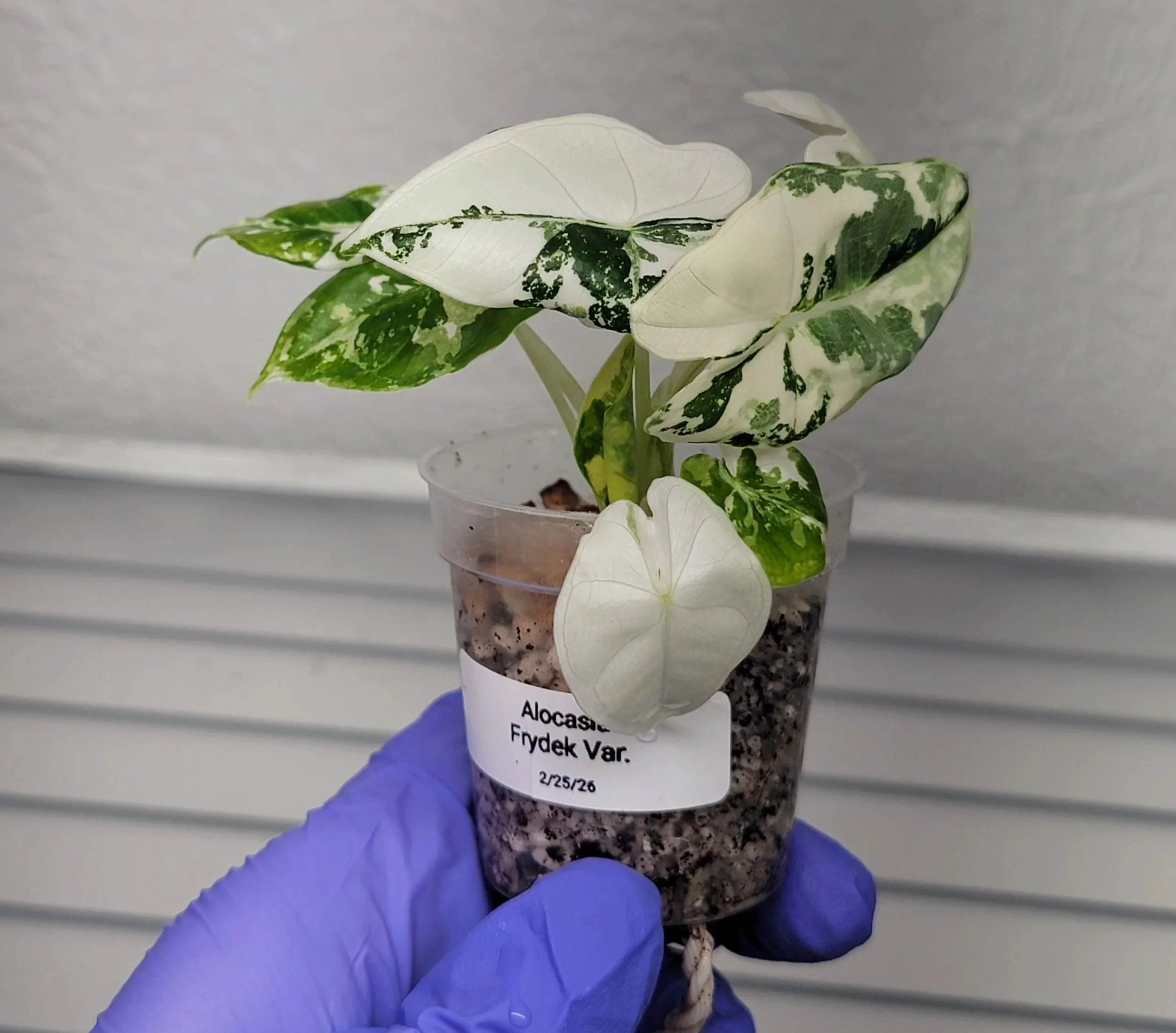
A grower's field guide to the velvet-leafed aroid with the split personality — half deep forest green, half ghost white. Everything on light, water, soil, humidity, and keeping a high-variegation specimen alive and thriving.
Light
Bright, indirectNo direct midday sun on white patches
Water
When top 2–3cm dryConsistent, never soggy or bone-dry
Humidity
60–80%Below 50% invites crispy edges
Soil
Dense & moisture-retentiveNot a chunky aroid mix
Temperature
18–27°C (65–80°F)Protect from cold drafts below 15°C
Toxicity
ToxicCalcium oxalate — keep from pets & kids
Alocasia Frydek Variegated isn't a beginner plant, and it doesn't pretend to be. It's a chimeral sport of the standard velvet-leaf Frydek — every white sector on its leaves is tissue with little to no chlorophyll, which means the plant is, quite literally, working with half the engine of a normal aroid. Understood correctly, though, it's not fragile. It's specific. Get the specifics right and it rewards you with some of the most striking foliage in the aroid world.
Light requirements
In the wild, this plant grows on the shaded floor of Southeast Asian forests, catching dappled light filtered through a canopy above it — never harsh, never direct, but never dim either. That's the exact target indoors: bright, indirect light, ideally the kind you'd get a couple of feet back from an east- or north-facing window, or filtered through a sheer curtain in a south- or west-facing one.
Ideal placement
1–2m from a bright window
Artificial light
12–14 hrs under a grow light
The white sectors change the math a little. Because variegated tissue has less or no chlorophyll, it can't photosynthesize efficiently, and it also can't dissipate light energy the way a fully green leaf can — direct sun scorches white patches noticeably faster than it scorches green ones. At the same time, too little light causes the plant to try to compensate by producing more chlorophyll, which is exactly how a variegated Frydek slowly reverts to solid green over successive leaves.
Bright enough that a new leaf holds its variegation pattern, soft enough that the white sectors never crisp. If leaves are reverting greener, nudge it closer to the light. If white patches are browning or bleaching, pull it back or diffuse the light further.
Water requirements
Alocasias as a genus want to feel like they're standing in a rainforest, not a desert and not a swamp: consistently moist, never waterlogged, never bone-dry. Frydek Variegated is less forgiving of extremes than the plain green form — the white tissue wilts and crisps faster when the plant gets thirsty, and the roots (already working with a lower-vigor plant) rot faster when they sit wet.
How to actually check
- Push a finger (or a wooden skewer) 2–3cm into the soil.
- If it comes out with soil clinging and feels damp, wait.
- If the top layer has dried out and the skewer comes out clean, water thoroughly until it runs from the drainage holes.
- Let the pot finish draining completely — never let it sit in a saucer of standing water.
Depending on your home's light, temperature, humidity, and pot size, that usually lands somewhere between every 5–9 days in active growth (spring/summer) and every 10–14 days in the slower winter months. Treat those numbers as a starting point, not a schedule — the finger test overrides the calendar every time.
Drooping, deflating-looking leaves usually mean underwatering. Yellowing lower leaves, a sour smell from the pot, or dark mushy stem tissue at the soil line mean overwatering or early rot — act immediately by checking the roots.
Water quality matters more here than with tougher houseplants. Frydeks (and variegated ones especially) can be sensitive to the chlorine, fluoride, and dissolved salts in tap water, which show up as crispy brown leaf margins over time. Filtered water, rainwater, or tap water left out uncovered for 24 hours (to let chlorine gas off) all reduce that risk.
Soil requirements
This is where a lot of well-meaning aroid growers get Alocasias wrong. The popular "chunky aroid mix" — heavy on bark, perlite, pumice, and orchid bark — was built for epiphytic and hemi-epiphytic climbers like Monstera and Philodendron, plants whose roots evolved to grab onto bark and pull moisture from humid air between waterings. Alocasias are not epiphytes. In the wild they root into dense, moisture-holding rainforest floor soil, and their fine, fibrous root systems are built to stay in constant contact with evenly moist substrate — not to sit in big air gaps between chunks of bark.
A too-chunky mix dries out unevenly and too fast around Alocasia's fine roots, which is a frequent, under-diagnosed cause of the "my Alocasia keeps drooping no matter what I do" problem. The fix is a mix that's airy enough to prevent compaction and rot, but dense and moisture-retentive enough to stay evenly damp between waterings — closer to a rich, well-draining potting soil than a bark mix.
A Frydek-friendly soil mix
The small amount of fine bark adds just enough structure to stop compaction; the worm castings add slow-release nutrition and improve water retention without waterlogging. Whatever mix you land on, the non-negotiable is a pot with real drainage holes — dense, moisture-retentive soil in a pot without drainage is a recipe for rot.
Caring for a high-variegation specimen
Frydek Variegated isn't uniformly variegated — every leaf and every plant sits somewhere on a spectrum, from lightly flecked with cream to dramatic 50/50 half-moon splits to, occasionally, leaves that emerge almost entirely white. The higher the ratio of white to green, the more deliberately you need to grow it.
Why high variegation changes the rules
White tissue has little to no chlorophyll, so a highly variegated leaf is doing meaningfully less photosynthesis than a solid green one of the same size. That has a few real consequences:
- Slower growth. A high-variegation plant simply produces less energy, so new leaves take longer to push and the plant stays smaller than a green sibling grown side by side.
- Lower stress tolerance. With less photosynthetic reserve to draw on, high-variegation specimens recover from underwatering, cold snaps, or root disturbance more slowly, and are less forgiving of neglect.
- White tissue is physically weaker. It's more prone to scorch, bruising, and rot than green tissue, so handle it gently when cleaning leaves or moving the plant.
- Nearly all-white leaves are a liability. A leaf with almost no green can't sustain itself and often yellows or collapses early — it's living off energy the rest of the plant produces. That's normal, not a sign you're doing something wrong.
Practical adjustments
- Prioritize consistency over intensity in every input — light, water, humidity, temperature. High-variegation plants punish fluctuation more than they punish a slightly-off baseline.
- Don't chase pure white leaves. A plant that's balanced — plenty of green, elegant white sectoring — will out-grow and outlive one pushed toward maximum white, because it can still feed itself.
- If a leaf reverts fully green, you can leave it (it will actually help feed the rest of the plant) or prune it once a more variegated leaf has matured, depending on whether you're growing for display or for long-term plant health.
- If the plant pushes an all-white leaf, don't panic when it declines faster than its siblings — that's the leaf's chlorophyll-free tissue running out of borrowed energy, not a care mistake.
- Warmth matters more here. Keep high-variegation specimens above 18°C (65°F) consistently; cold slows an already-slower plant to a crawl and increases rot risk.
Humidity — tips and tricks
If there's one input Frydek Variegated is least forgiving about, it's humidity. Below roughly 50%, expect crispy brown margins, stalled new growth, and a general sulky look — and unlike light or water, humidity is the one factor most homes don't naturally provide. The genus evolved under a rainforest canopy at 70–90% humidity; 60–80% indoors is a realistic, healthy target.
Run a cool-mist humidifier
The single most reliable fix. Set it on a timer near the plant and pair with a cheap hygrometer so you're adjusting to a real number, not a guess. Aim the mist so it doesn't sit directly on the leaves for hours at a time.
Pebble tray with standing water
Fill a wide tray with pebbles or LECA, add water just below the top of the stones, and rest the pot on top without letting the drainage holes touch the water. Evaporation raises humidity in the immediate zone around the leaves.
Cluster your plants
Group Frydek with other humidity-loving aroids. Each plant releases moisture through its leaves (transpiration), so a tight cluster builds a noticeably more humid microclimate than any one plant alone.
Build a greenhouse cabinet
An IKEA cabinet or a glass/acrylic enclosure with a small humidifier or fan inside creates a stable, high-humidity microclimate — the closest you'll get to rainforest conditions at home, and often the difference-maker for a struggling high-white specimen.
The bathroom shelf trick
If a bathroom gets bright indirect light, it's often the most humid room in the house from daily showers. It won't replace a dedicated setup, but it's a genuinely useful free humidity boost.
Skip misting as a primary strategy
Misting the leaves feels productive but raises humidity for minutes, not hours, and can encourage fungal spotting on white tissue if water sits too long. Use it as an occasional supplement, not the plan.
A stable 60% is better for this plant than a humidity that swings between 40% and 90% throughout the day. Whatever setup you choose, the goal is flattening the daily swings, not just hitting a peak number once.
Creative self-watering systems you can build at home
Because Frydek Variegated wants moisture that's consistent rather than occasional, a self-watering setup solves two problems at once: it prevents the dry-then-drenched cycle that browns leaf edges, and it covers you when you travel. None of the following require special equipment.
The wine bottle spike
Fill a wine bottle with water, cap it with a terracotta watering spike (or invert it and push the neck a few centimeters into moist — not dry — soil). The soil's suction slowly draws water out as it dries, releasing more only when the surrounding soil actually needs it.
The buried terracotta olla
Bury an unglazed terracotta pot (plugged at the drainage hole) up to its neck in the soil and fill it with water, then cap it. Unglazed clay is porous — it seeps water outward exactly as fast as the surrounding soil dries, which mimics the constant, gentle moisture Alocasias actually evolved for.
Cotton wick self-watering
Thread a length of thick cotton cord or yarn from the drainage hole up into the root ball before potting, with the other end sitting in a reservoir of water below or beside the pot. Capillary action pulls water up the wick continuously, keeping the soil at a stable, moderate moisture level.
Upcycled bottle drip
Poke one or two small pinholes in the cap of a plastic bottle, fill it with water, and push it upside-down a couple centimeters into the soil near the pot's edge. Adjust the hole size by trial and error until the drip rate matches how fast your specific mix dries.
Nursery-pot-in-cache-pot reservoir
Keep the plant in its nursery pot with drainage holes, set it inside a slightly larger cache pot, and add a shallow layer of LECA or gravel plus a little water in the gap between the two. It builds humidity right at root level and adds a buffer against you forgetting a watering day, without the roots ever sitting directly in water.
Any passive system still needs occasional checking — soil type, pot size, and season all change how fast water is drawn. Treat these as tools that smooth out the gaps between your own checks, not as a total replacement for paying attention to the plant.
Feeding, repotting & propagation
Feeding
Feed during active growth (spring through early autumn) with a balanced houseplant fertilizer diluted to roughly half the label strength, every 4 weeks. High-variegation specimens in particular don't need — and won't use — heavy feeding, since they're photosynthesizing less and growing more slowly than a solid green plant; over-fertilizing just builds up salts that damage the sensitive white tissue. Skip feeding entirely in winter dormancy.
Repotting
Repot roughly every 12–18 months, or when roots start circling the pot's edge, sizing up only one pot size at a time (roughly 2–5cm wider). Alocasias resent being swamped in oversized pots — too much soil volume around a small root system holds excess moisture and raises rot risk, which hits variegated specimens especially hard. Spring is the best window, giving roots the whole growing season to recover.
Propagation
Frydek Variegated grows from a central rhizome/corm and produces offsets (pups) at the base once mature. Once a pup has a few of its own leaves and visible roots, separate it from the mother plant with a clean cut, let the cut surface callous for a few hours, and pot it into the same moisture-retentive mix as the parent. Because variegation is chimeral, pups can emerge more variegated, less variegated, or fully green compared to the parent — there's no guaranteed way to predict or force a pup's exact pattern.
Pest prevention
Frydek Variegated isn't more pest-prone than other aroids by nature, but its lower vigor means an infestation takes a bigger toll before you notice it, and the soft, chlorophyll-poor white tissue is a favorite target for sap-suckers. Prevention is much easier than treatment here — a few minutes a week beats weeks of quarantine and neem oil later.
Build prevention into your routine
- Quarantine every new plant for 2–3 weeks in a separate room before it goes near the rest of your collection, even ones that look clean at the nursery.
- Inspect leaf undersides weekly, especially along the midrib and in new, unfurling growth — that's where mites, thrips, and mealybugs tend to hide first.
- Wipe leaves down periodically with a soft, damp cloth. This does double duty: it keeps pores clear for gas exchange and physically removes early-stage eggs and pests before they establish.
- Keep airflow moving. A small fan on low nearby helps prevent the stagnant, still air that spider mites and fungal issues both prefer, without undercutting the humidity this plant needs.
- Don't let soil stay wet longer than necessary — overly saturated soil is the single biggest driver of fungus gnat infestations, since gnats lay eggs in damp organic matter.
- Use yellow sticky traps in the pot as an early-warning system. They won't solve an infestation on their own, but a trap that suddenly fills up is a signal to inspect closely before it becomes a bigger problem.
- Preventive neem oil, diluted and applied to leaves every few weeks during the growing season, deters most common pests without harming the plant when used correctly — avoid applying it in direct sun.
What to watch for
- Spider mites — fine webbing and tiny pale stippling on leaves, worst in low humidity. Raising humidity is both prevention and part of the cure.
- Thrips — silvery, streaky scarring on leaves and small black flecks of frass. They spread fast between nearby plants, so isolate immediately if spotted.
- Mealybugs — small white cottony clusters, usually in leaf axils or along the stem. Dab visible clusters with rubbing alcohol on a cotton swab as soon as you see them.
- Fungus gnats — small flies around the soil surface. Harmless to the plant in low numbers, but a sign the soil is staying wetter than it should between waterings.
- Scale — small, immobile brown bumps along stems and leaf undersides. Easy to miss since they don't move; check carefully during routine wipe-downs.
Isolate the plant immediately, treat both the foliage and the soil surface, and keep checking nearby plants for a week or two afterward — most houseplant pests spread readily to neighbors before you notice the first sign on the original plant.
Troubleshooting quick-reference
| Sign | Likely cause |
|---|---|
| Crispy brown leaf margins | Low humidity, tap water minerals/chlorine, or underwatering — check humidity first. |
| Yellowing lower leaves | Usually overwatering or a pot without adequate drainage; check the roots for rot. |
| Drooping, deflated leaves | Most often underwatering; if soil is already wet, suspect root rot instead. |
| New leaves emerging smaller and greener | Not enough light for the plant to sustain its variegation — move it brighter (indirect). |
| Scorched or bleached white patches | Direct sun hitting the chlorophyll-poor variegated tissue; move out of direct light. |
| Fine webbing, stippled leaves | Spider mites, which thrive in low humidity — raising humidity helps prevent and treat. |
| Dark, mushy stem at the soil line | Stem/root rot — unpot, trim affected tissue with a sterile blade, repot in fresh dry mix. |
| Slow or stalled growth on a high-white plant | Often normal — expect a naturally slower pace the more white the leaves carry. |
Frequently asked questions
Is Alocasia Frydek Variegated a good plant for beginners?+
Not typically. It demands more consistency in humidity, watering, and light than most houseplants, and its variegated tissue leaves less margin for error. It's a great second-or-third aroid once you're comfortable reading a plant's signals — not usually a first plant.
Why is my plant losing its variegation and turning green?+
Insufficient light is the most common cause — the plant produces more chlorophyll to compensate for low energy input, and that shows up as greener new growth. Moving it somewhere brighter (still indirect) often brings variegation back on subsequent leaves.
Can I use a chunky aroid mix if that's what I already have?+
You can, but expect to water noticeably more often, since a chunky mix dries out fast around Alocasia's fine root system. Amending it with extra potting soil and worm castings to make it denser will serve the plant better long-term.
Is it normal for older leaves to yellow and drop over time?+
Yes — losing one older leaf occasionally as a new one emerges is normal turnover. It's only a concern when multiple leaves yellow at once, or when younger leaves are affected too.
Does it need to go dormant in winter?+
Alocasias often slow down and can even lose a leaf or two in low-light winter conditions — that's a natural semi-dormancy, not a crisis. Reduce watering frequency slightly, hold off on fertilizer, and resist the urge to overcorrect.
Are the white parts of the leaf more delicate to touch or clean?+
Yes. Dust white sectors gently with a soft, damp cloth rather than wiping firmly, and avoid leaf-shine products, which can clog the more fragile variegated tissue.